Hak sewa
- Term
- The term is that of the contract. This is not a right of 25, 30 or 80 years.
- Point of care
- Assignment of the remaining right exists only if the contract authorises it.

Investing in Lombok
By Mathieu MAILLOT — 8 min read
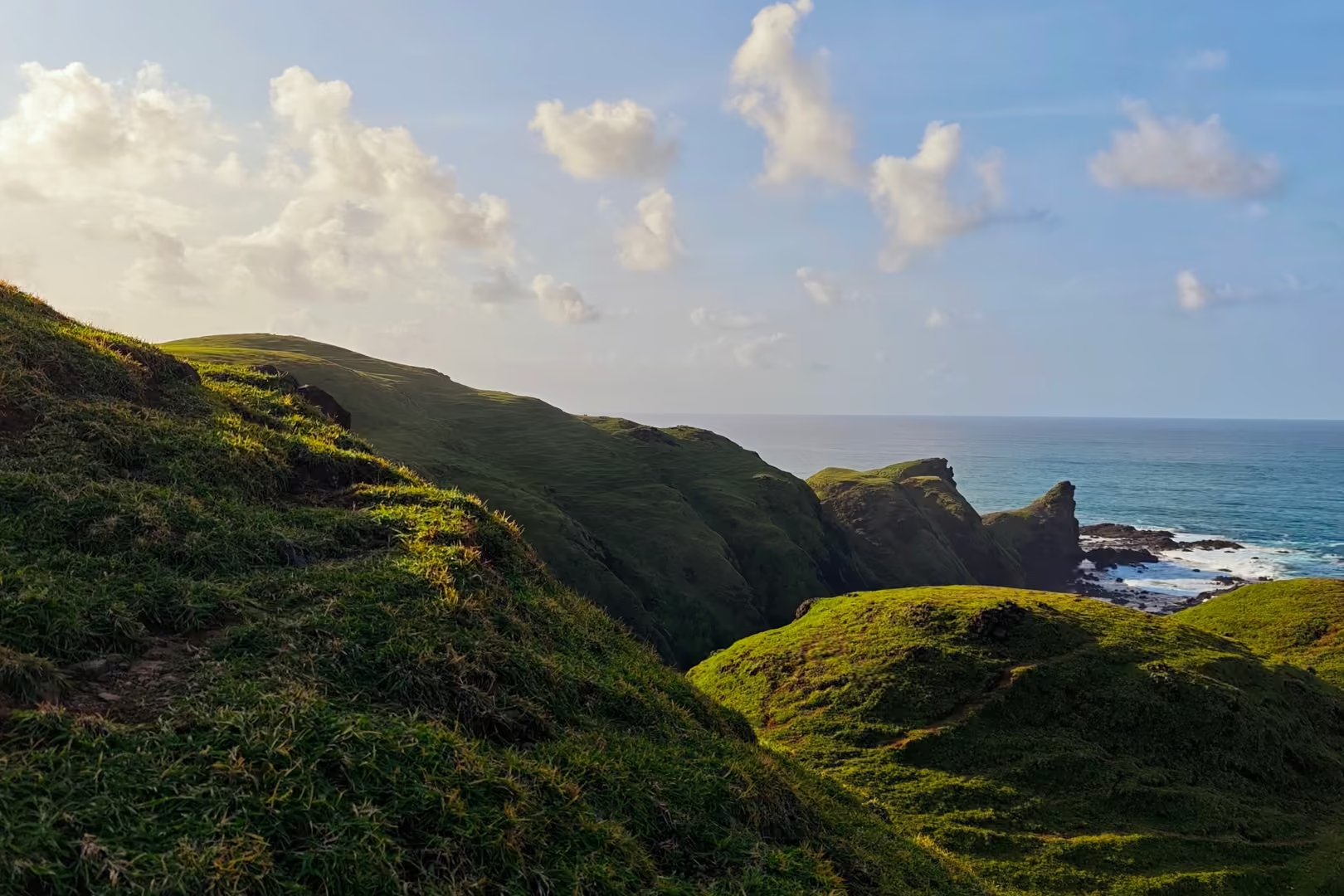
Lombok is attracting a growing number of international investors thanks to its preserved landscapes and its quiet pace of life. However, when it comes to buying a villa for sale in Lombok or land for sale in Lombok, Indonesian property law imposes precautions that foreigners cannot avoid. What, then, are the real options for gaining access to property or investing on the island? By looking at the different types of property rights in Indonesia — hak milik, hak pakai, HGB, hak sewa (leasehold) — and at investment through a PT PMA, you will see which lawful strategies to favour.
What does Indonesian law say about land ownership?
Indonesian property law distinguishes several land statuses, each with its own rights. Government Regulation No. 18 of 2021 sets, in particular, the ceilings for HGB and hak pakai on state land. Text of the regulation: PDF of regulation No. 18 of 2021. To complete a purchase in Lombok as a foreigner, it is essential to understand these nuances before you commit.
In practice, the local offer is organised around full ownership (freehold), a long lease (leasehold) and temporary rights such as hak pakai or HGB. Using a foreign-investment company (PT PMA) also changes your acquisition prospects, notably for those who want to operate the property commercially.
On the Indonesian market, four main regimes structure transactions:
These types of property right in Indonesia determine what is possible when buying property in Lombok, but not all of them are directly open to foreigners. A careful check of the land title, the zoning and the administrative authorisations is required before any transaction.
Always check that the title is in order and that the purchase procedure is lawful, so as to avoid any future dispute.
Hak Milik guarantees total and unlimited ownership of a piece of land. This status remains strictly reserved for Indonesians. A foreigner cannot directly acquire land under Hak Milik. A nominee arrangement is not a recognised holding. Its consequences depend on its structure, the facts and the applicable law. The legal risk is real. Cancellation of the title is not automatic.
Non-Indonesians who want to invest therefore have to consider lawful alternatives, each with its advantages and constraints.
Faced with the ban on direct access to Hak Milik, several solutions exist: leasehold (a long lease), hak pakai, or the use of a PT PMA to obtain certain titles such as HGB. Each option has its own term, its restrictions and its renewal conditions.
These alternatives and their implications must be analysed before any financial commitment. Here is how they work in practice:
To buy a villa or land in Lombok, hak sewa is often the path used by foreigners. It is a transferable lease, for the term written in the contract. The 80 years are not a right negotiated as a single block: they are the successive ceilings of HGB and hak pakai on state land, under Government Regulation No. 18 of 2021. Hak sewa allows the remaining right to be assigned if the contract authorises it.
To support legal security, the contract must state the term precisely, the renewal mechanics, and clearly fix the original owner’s involvement in the event of resale or succession.
Hak pakai is a right of use. On state land, its fixed term follows the ceilings of 30 years, then 20 years, then 30 years, in stages. The conditions, including those on residence, are confirmed with a lawyer and with the National Land Agency (BPN).
This mechanism legalises registration of the property in the buyer’s name with the authorities, which reassures many investors. Note, however: commercial use is not automatically permitted under this status.
HGB allows land to be built on and operated. On state land, Government Regulation No. 18 of 2021 caps it at 30 years, then an extension of no more than 20 years and a renewal of no more than 30 years. It is a framework used for a commercial activity. A foreign individual does not hold an HGB in their own name. This right is held by an Indonesian legal entity. A PT PMA can be that legal entity when the activity and the investment regulation allow it.
Setting up a PT PMA brings obligations of capital, reporting and management. The amount of capital is read in the regulation in force and confirmed before incorporation. This route concerns operating projects. It does not guarantee a yield.
Hak sewa
Hak pakai
HGB, through a company
Nominee
| Method | Term | Point of care |
|---|---|---|
| Hak sewa | The term is that of the contract. This is not a right of 25, 30 or 80 years. | Assignment of the remaining right exists only if the contract authorises it. |
| Hak pakai | On state land: 30 years, then 20 years, then 30 years. Each stage must be applied for. | Stay conditions are confirmed. Commercial use is not automatic. |
| HGB, through a company | The same successive ceilings on state land. Not a single 80-year lease. | A PT PMA can hold this right if the activity allows it. It does not guarantee a yield. |
| Nominee | This is not a recognised way to hold hak milik. | The consequences depend on the file. They are not automatic. |
A successful property investment in Lombok depends on precise checks: the quality of the land title, respect for zoning, the administrative position of the property, the real term of the leasehold or of the hak pakai. All of these points condition the ability to let, assign or mortgage the property.
It is strongly advisable to consult an experienced local notary to validate that the process is in order. Promises of full ownership through a nominee should be set aside. A nominee is not a recognised way to hold hak milik. The consequences depend on the facts and are confirmed with a lawyer. They are not automatic.
No. Hak milik is not available to a foreigner. The frameworks to examine are hak sewa, hak pakai and, for a commercial activity, a company able to hold an HGB. None of these frameworks opens full ownership of the land.
This arrangement is not a recognised holding of hak milik. It is not recommended, even when an intermediary proposes it. Its exact effects are confirmed with a lawyer. They are not summarised here as a total loss of the property or as automatic proceedings.
A PT PMA may suit a commercial activity if the activity code and the authorisations allow it. On its own, it does not authorise every tourism activity. A hak sewa is not a licence either.
Yes, provided the contract expressly contains renewal and transmission clauses. The lease must be drafted by a professional in order to protect your interests over several decades.
Setting up a PT PMA involves administrative and accounting costs and a minimum capital. It does, however, secure a property investment in Lombok and opens the door to professional rental income. This choice is relevant for an ambitious project.
Despite a restrictive regulatory framework, several reliable options now exist for investing in property in Lombok: leasehold, hak pakai, a PT PMA. Each has strengths to weigh against your project. Taking advice from local specialists, checking the quality of the titles and keeping a long-term view remain essential to establishing yourself on this promising island, while complying carefully with Indonesian property law.

We advise international investors looking in Bali and Lombok: location, budget, how to hold the asset, and which projects to consider.